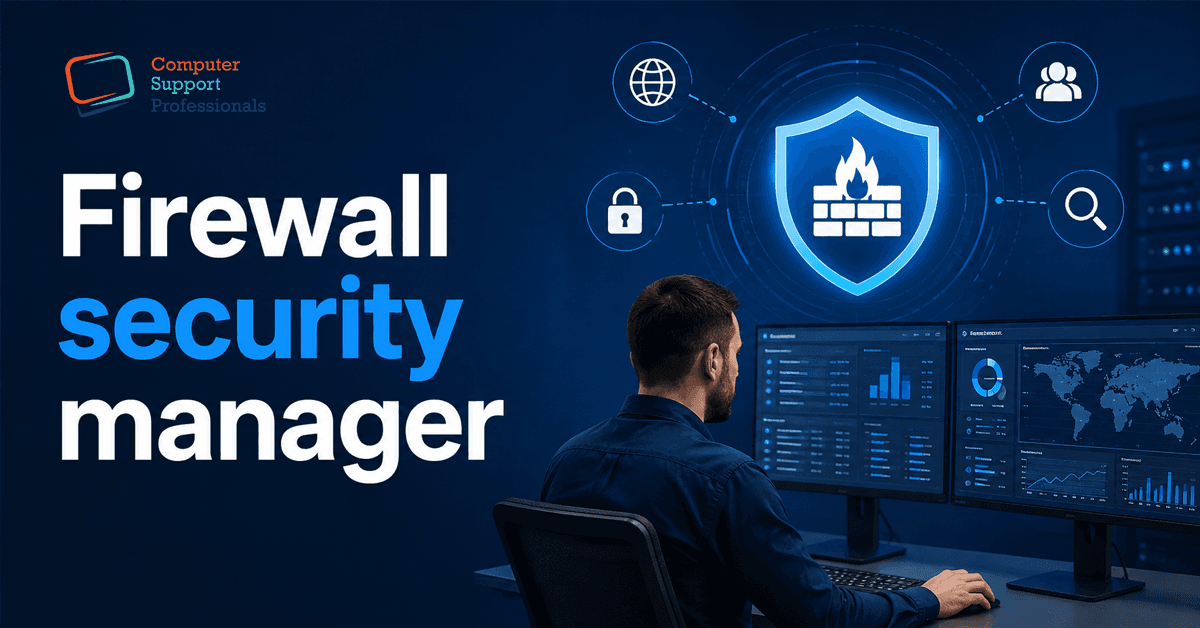
Every network breach starts somewhere - and in most cases, it starts where a firewall should have stopped it. A firewall security manager is the person responsible for making sure that does not happen.
A firewall security manager is responsible for the configuration, maintenance, and monitoring of an organisation’s firewall infrastructure. Their role ranges from designing network security policies to responding to real-time threats. It also ensures that unauthorised traffic never reaches systems or data.
In the Australian context, this role carries additional weight. With cyber threats rising sharply and frameworks like the ASD Essential Eight and the Australian Cyber Security Centre (ACSC) guidelines now shaping how businesses must protect their networks, a skilled firewall security manager is not a luxury - it is a business requirement.
Whether an organisation operates with an in-house security team or relies on a managed security services provider (MSSP) like CSPRO, understanding this role is critical to making informed decisions about your network security posture.
Why Firewall Management Matters for Australian Businesses
Australia's threat landscape has changed dramatically. The Australian Signals Directorate (ASD) recorded a cybercrime report every six minutes during the 2022-23 financial year. Ransomware, business email compromise, and supply chain attacks continue to target Australian organisations of all sizes - and the costs are substantial.
A firewall is your first - and often most important - line of defence. But a firewall that is not properly managed is almost as dangerous as no firewall at all. Misconfigured rules, outdated policies, and unmonitored logs leave organisations exposed to threats that sophisticated attackers exploit daily.
Key Roles and Responsibilities of a Firewall Security Manager
A firewall security manager plays multiple roles in the IT security field. Their responsibilities are both technical and strategic, requiring a combination of hands-on network engineering skills and broad security governance knowledge.
1. Firewall Policy Design and Implementation
At the core of this role is the design of firewall rule sets and security policies. A firewall security manager determines what traffic is permitted, what is denied, and how those decisions are enforced across the entire network perimeter - and increasingly within the network itself through east-west traffic controls.
- Defining access control lists (ACLs) and traffic filtering rules
- Implementing network segmentation to isolate sensitive systems
- Configuring DMZ (demilitarised zone) environments for public-facing services
- Setting up VPN policies for remote access and site-to-site connectivity
- Documenting all firewall rules with business justification and owner accountability
2. Continuous Monitoring and Threat Detection
Firewalls generate enormous volumes of log data. A firewall security manager continuously monitors data for patterns and indicators of compromise (IOCs).
- Monitoring network traffic and firewall logs in real time
- Integrating firewalls with Security Information and Event Management (SIEM) platforms for event correlation
- Identifying and escalating suspicious activity to the security operations centre (SOC)
- Threat intelligence feed management - ensuring the firewall recognises known malicious IPs, domains, and signatures
- Establishing and tuning alert thresholds to minimise false positives
3. Firewall Rule Auditing and Change Management
Firewall rules are added for a specific purpose and are never removed, creating an unnecessary attack surface. The firewall security manager is responsible for ensuring that rule sets are clean, current, and compliant.
- Periodic rule-based reviews - typically quarterly or after any significant network change
- Structured change management process - ensuring all rule changes are authorised, documented, and tested before deployment
- Removing redundant, unused, shadowed, or conflicting rules
- Maintaining a complete audit trail for compliance purposes and incident investigation
4. Incident Response
When a security incident occurs - or is suspected - the firewall security manager plays a critical role in containment and investigation. Furthermore, a security manager removes compromised sections of the network, blocks malicious traffic sources, and preserves log evidence for analysis.
- Implementation of rules to block attack sources.
- Gather network traffic and conduct deep analysis during active incidents.
- Policy assessment and upgrade of the firewall after the event.
- Compliance reporting and interaction with stakeholders.
5. Compliance and Regulatory Alignment
Businesses in Australia that operate under the Privacy Act 1988, the NDB plan, or policies linked to ACSC are required to meet specific technical requirements around network security. Furthermore, a firewall security manager makes sure that the firewall infrastructure supports and provides evidence of compliance with these requirements.
- Mapping firewall controls to ASD Essential Eight mitigation strategies
- Supporting Privacy Impact Assessments (PIAs) with documented network security controls
- Preparing firewall configuration reports for internal and external compliance audits
- Advising on network architecture changes to maintain the ongoing compliance posture
Firewall Security Manager vs Network Administrator
These two roles are frequently confused - and sometimes combined in smaller organisations. Understanding the distinction helps businesses make better staffing and outsourcing decisions.
| Attribute | Firewall Security Manager | Network Administrator |
| Primary Focus | Security policy, threat prevention, compliance | Network connectivity, performance, and availability |
| Core Tools | NGFW, SIEM, policy management platforms | Routers, switches, and network monitoring tools |
| Certifications | CISSP, CCSP, Fortinet NSE, Palo Alto PCNSE | CCNA, CompTIA Network+, JNCIA |
| Incident Role | Lead security containment and forensic investigation | Restore connectivity; support the security team |
| Compliance Focus | High - maps technical controls to frameworks | Low - focused on functional network operation |
| Reports To | CISO / Security Director | IT Manager / Infrastructure Lead |
| Outsourced via MSSP? | Yes - commonly via managed security services | Sometimes - via managed network services |
Firewall Policy Lifecycle
A well-managed firewall does not operate on a set-and-forget basis. A professional firewall security manager will maintain a structured policy lifecycle for continued effectiveness and compliance.
- Policy Design - Identify business, security, and compliance needs.
- Implementation - Implement rules in the firewall with appropriate change management controls
- Monitoring and Alerting - Continuously monitor logs, traffic anomalies, and alert thresholds.
- Rule Auditing - Conduct quarterly or bi-annual rule-based reviews.
- Incident Response - On detection of a security event, invoke the IR process.
- Compliance Reporting - Generate evidence for audit purposes.
- Continuous Improvement - Use lessons from incidents and audits to harden policy, refine monitoring, and improve response processes.
Next-Generation Firewalls (NGFW) and Modern Threats
Traditional firewalls were able to block only IP addresses, ports, and protocols. Nowadays, encrypted malware application-layer attacks and network lateral movement demand a far more complex approach.
Next-generation firewalls (NGFWs) add capabilities that legacy firewalls simply cannot provide:
1. Application-Layer Visibility
NGFWs identify and control specific applications - blocking Tor, controlling social media usage, or permitting only authorised SaaS tools - regardless of port or protocol. This level of granularity is impossible with traditional firewall technology.
2. Intrusion Prevention System (IPS)
Built-in IPS capabilities allow NGFWs to detect and block known exploit signatures, vulnerability scans, and attack patterns in real time - without requiring a separate IPS appliance and reducing both cost and complexity.
3. SSL/TLS Decryption and Inspection
With over 90% of web traffic now encrypted, NGFWs must decrypt, inspect, and re-encrypt SSL/TLS sessions to identify malware hidden within encrypted traffic - a critical capability that legacy firewalls lack entirely.
4. Threat Intelligence Integration
Real-time threat intelligence feeds are being used with next-generation firewalls, which automatically block malicious IP addresses and file hashes without manual rule modifications. This dramatically reduces mean time to respond (MTTR) to emerging threats.
5. Zero Trust Architecture Support
As organisations move toward zero trust security models - where no user or device is trusted by default - NGFWs play a central role in enforcing micro-segmentation and identity-based access control. A firewall security manager must understand how to configure NGFWs to support a zero-trust posture across hybrid cloud and on-premises environments.
Conclusion
A firewall security manager is far more than someone who configures a firewall and moves on. They are the ongoing guardians of your network perimeter, continuously monitoring, adapting, and enforcing the policies that keep your business, your data, and your customers protected against an increasingly sophisticated threat landscape.
For Australian businesses, the stakes are higher than ever. With ASD recording a cybercrime incident every six minutes, and regulatory obligations under the Privacy Act 1988 and the ASD Essential Eight demanding demonstrable technical controls, professional firewall management is not optional; it is a business-critical function.
Whether you operate a small professional services firm or a large enterprise, CS-Pro can help you achieve the firewall security posture your business needs without the overhead, cost, and risk of building an in-house team from scratch.