In today’s modern era, every small and large business relies on its data. Company files, customer information, financial records, and other important information are all stored in computer systems. If a system suddenly crashes, a server goes down, there is a power outage, or a hacking attack occurs, all this data can be lost.
This can cause financial loss, loss of time, and damage to the business’s reputation. Disaster recovery solutions are used to avoid these risks, so that data can be restored quickly and safely after any accident.
What is disaster recovery?
Disaster recovery is a systematic process that supports a company in difficult situations. With its help, if a company’s data is lost or the system suddenly shuts down, it can be quickly restored. Nowadays, most businesses run on computers and online systems, so any failure can cause major damage.
This failure can occur in the event of natural disasters such as floods or earthquakes, power outages, hacker attacks (cyber attacks), or sudden system failure. Disaster recovery helps businesses get back on their feet in such situations.
Cloud-based disaster recovery
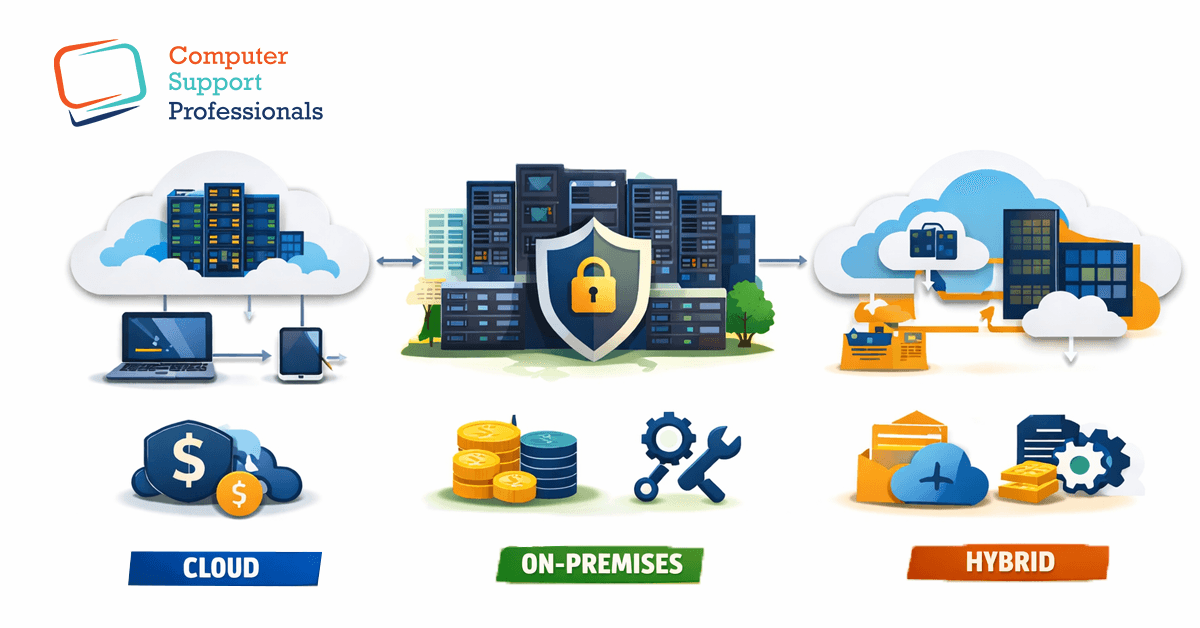
In cloud disaster recovery, a company stores its important data on a cloud server via the Internet. This means that the data is stored on an online service, which can be accessed immediately when needed. If the system crashes or there is a problem in the office, the data is safe and can be restored.
✔ Advantages
A cloud solution is usually less expensive because the company does not need to buy expensive hardware. It is also easy to set up and does not require much technical expertise. The biggest advantage is that the data can be accessed from anywhere. The backup and recovery process is also faster.
✖ Disadvantages
| Feature | Cloud | On-Premises | Hybrid |
| Cost | Low | High | Medium |
| Control | Low | High | Medium |
| Security | Good | Very High | Very Good |
| Flexibility | High | Low | High |
The biggest disadvantage of this system is that it is completely dependent on the Internet. If the Internet goes down, access can be difficult. In addition, there may be some security concerns, and the company has to pay a fee every month.
On-Premises Disaster Recovery
In on-premises disaster recovery, a company stores all its data and systems in its own office or data center. That is, the servers, storage, and other equipment are located on the company’s premises. In this way, the company has complete control over its data and can monitor it itself.
✔ Advantages
The biggest advantage of this model is complete control. The company creates its own security policy, and the data remains under its own supervision. Security is usually stronger because the data is not held by any third party outside. In addition, this system can also work without the Internet.
✖ Disadvantages
This method is more expensive because it requires the purchase of servers and hardware. These devices also require maintenance, which costs more. Its setup can also be complex and requires expert IT staff.
Hybrid Disaster Recovery
In the hybrid disaster recovery model, both cloud and on-premises systems are used together. That is, some data is stored in the company’s office or data center, and some data is stored in the cloud. In this way, the company gets the benefits of both methods.
✔ Advantages
The hybrid model has more flexibility, because the company can store data in different places according to its needs. It also improves security because there is a dual system for backup. If one system fails, the other system helps restore data.
✖ Disadvantages
This model can be somewhat difficult to manage because two different systems have to be managed simultaneously. In addition, its cost is usually higher than average, because it costs both the cloud service and its own hardware.
Comparison of All Three Solutions
Conclusion
Not every company has the same needs. Some companies have a small budget, while others prioritize security. That is why choosing a disaster recovery solution should be done carefully. If a company has a small budget and wants to protect its data at a low cost, a cloud solution can be a good choice. It does not require purchasing hardware, and the costs are relatively low.
If security is the most important thing for an organization and it wants complete control over its data, an on-premises system is better. In this, the data is stored in the company’s own office.
Whereas, if a company wants a balance between both, that is, better security with reasonable cost, then a hybrid model is the best option. The right choice protects the business from major financial losses and keeps the system safe and stable.