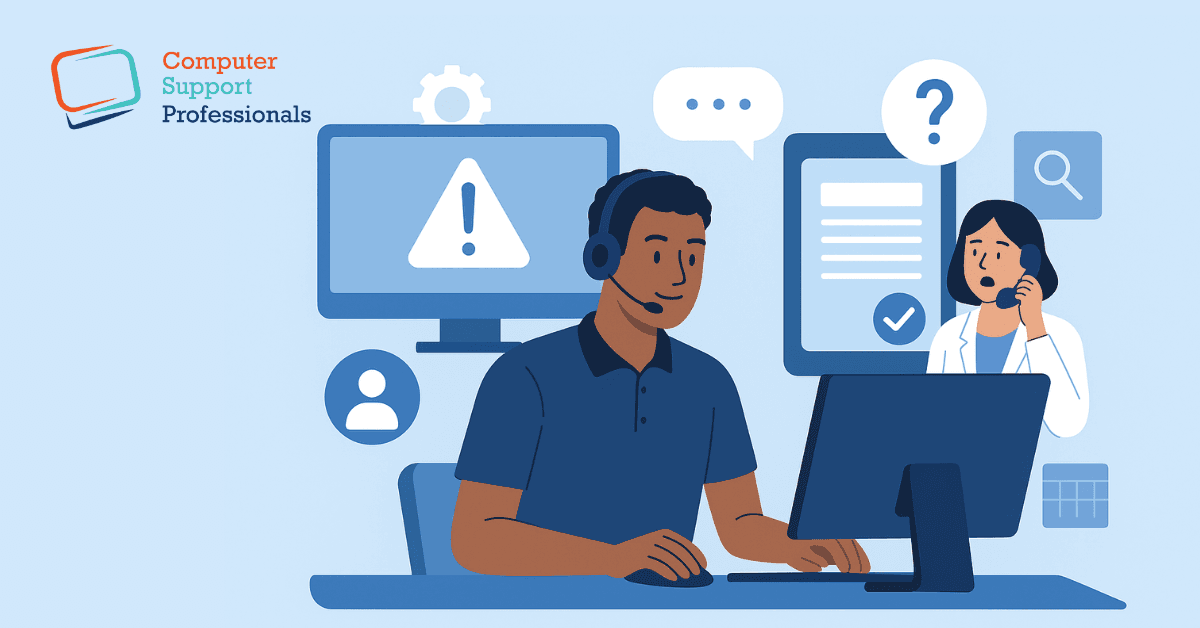
A competent IT help desk is essential to operational continuity and worker efficiency in today’s digital company environment. Every minute of downtime from a frozen application to a network outage costs money, frustrates workers, and exposes them to security risks. First-line defense: a good IT help desk service solves issues quickly and makes technology work for you. Not all help desks are alike. A great service provides proactive assistance, skilled advice, and strategic value beyond break-fix solutions. This book covers the fundamental functions, critical features, and differentiators you should anticipate whether you need on-site IT assistance or managed service provider pricing to fit your budget.
Core Functions of a Quality IT Help Desk
As a multifaceted engine, a contemporary IT help desk is intended to handle the complete spectrum of user problems and requests via the use of procedures that are both organized and efficient. Its major objective is to minimize disruptions to the daily operations of the company while simultaneously restoring regular service operations as rapidly as feasible.
1. -Incident Management
This is how to deal with unexpected problems with IT services or declines in quality. A competent help desk keeps track of, sorts, prioritizes, and fixes these problems, from a single user’s email problem to a software disaster that affects the whole department. By ranking resources by severity and business impact, such as Critical/High/Medium/Low, you can make sure they are used correctly. A major server failure would be addressed right away, but a mouse request would be processed as usual. The strategy entails putting the answer in a knowledge base so that future solutions can be found more quickly. This becomes reactive firefighting into a chance for the organization to learn.
2. -Service Requests Handling
Service requests differ from incidents in that they are standard, low-risk requests for access to services or information. Examples of service requests include routine tasks such as password resets, software installation requests, access permission changes, or the provisioning of new equipment, like help desk computers.
A streamlined help desk automates and standardizes these requests through a dedicated portal, allowing users to submit them easily while enabling technicians to fulfill them quickly using pre-approved workflows. This structured process reduces friction associated with everyday IT needs, significantly enhances the user experience, and allows technicians to concentrate on more complex problem-solving.
3. -Remote & On-Site Support
Flexible support models offer the right level of help at the right time. Secure remote access tools effectively fix most software configuration, driver updates, and minor troubleshooting issues. Technical support can view a user’s screen and control their device to apply fixes instantly without travel costs. Hardware, network infrastructure, or specialized peripherals need human touch from time to time. If something goes wrong at the help desk, there should be clear ways to get skilled IT guys to the scene. This mixed method works well in all situations and has the fastest resolution times and lowest costs.
Key Features of IT Helpdesk Service
These six characteristics are non-negotiable signs of a mature, user-centric IT help desk service, and they should be taken into consideration while assessing prospective suppliers.
1. -24/7 Availability
A 9-to-5 schedule that is consistent throughout all time zones is not always adhered to by the contemporary workforce. Whenever there are offices worldwide, online teams, and staff members who work in shifts, there is always the possibility that technical issues may arise. Any employee who is working late on a project or a colleague who is in a foreign branch may get the same level of assistance as those who are in the main office during regular business hours if the help desk is available around the clock. A vital component of maintaining a firm and ensuring that staff are content is providing them with access around the clock.
2. -Multi-Channel Support
The way individuals choose to communicate varies. For some people, the ease of live chat is more appealing than the immediacy of a phone conversation, while others like the documentation trail that email provides. Providing omnichannel support-phone, email, online portal, chat, and sometimes even integration with collaboration technologies like Microsoft Teams or Slack-is one of the most effective ways for a superb help desk to meet people where they’re at. By ensuring that no request is lost, regardless of where it was submitted. A centralized ticketing system also guarantees that users are provided with clear updates on the progress of their tickets. The increased user adoption of the support function and the speedier reporting of issues are both due to this flexibility.
3. -Skilled and Certified Technicians
These tools are only as effective as the individuals who make use of them. It is reasonable to anticipate that the individuals working at your help desk will be trained IT specialists rather than generalists. And it is important to look for technicians who have appropriate certificates, such as CompTIA A+, Microsoft 365 Fundamentals, or ITIL 4 Foundation. Which certify their competence in the areas of hardware, core software, networking, and new cloud platforms.
It is because of this experience that they can appropriately set up a cloud application, diagnose a confusing network latency problem, and discern between a malware attack and a system fault. In addition, a good information technology provider will make investments in continual training for its staff to guarantee that their capabilities will keep pace with the changing technological world. Because of this dedication to expertise, your workers may even be able to further their careers inside your own business. As they will gain knowledge by engaging with support experts who are skilled.
4. -Fast Response & Resolution Times (SLAs)
Transparency and responsibility are very important. A professional help desk works under well-defined Service Level Agreements (SLAs), which are part of the price system for a managed service provider. These SLAs set clear goals for performance, such as:
First Response Time:How quickly will a technician initially acknowledge and begin working on a ticket?
Resolution Time:Target timeframes for resolving issues based on their priority level.
Update Frequency:How often a user will receive communication on an ongoing issue.These guarantees ensure your business isn’t left guessing and holds the provider accountable for maintaining a high standard of service.
5. -Proactive Monitoring & Maintenance
The best help desks prevent problems before users see them. Remote Monitoring and Management (RMM) technologies allow a proactive service provider to monitor your servers, network devices, workstations, and backups. Broken hard drives, inadequate storage, and strange network activity are found. Security patches, software updates, and after-hours maintenance may be automated or done by an expert. From “wait for it to break” to “preventative” decreases disruptions and stabilizes systems.
How to Evaluate the Right IT Help Desk Provider
Get the appropriate partner by researching. Review their technical skills and certifications to ensure they can support your technological stack. Do their SLAs meet business standards and are realistic? Know their challenging circumstance escalation strategies and technological levels.
Reliable, scalable, and value-driven managed service provider pricing should have no hidden fees. Get similar company customer references and case studies. Lastly, evaluate their culture and communication style; you need a partner that is responsive, honest. And easy to work with in good times and bad.
Conclusion
A great IT help desk service may boost a company’s productivity, security, and morale. The IT team becomes a strategic enabler of seamless and continuous operations instead of a cost center with disruptions. Customers may rest easily with a skilled help desk that provides a single point of contact for all technical issues. It combines remote and on-site IT support, and follows explicit service level agreements.
Consider more than the help desk, computers, and break-fix service when choosing an IT provider. Find a partner who can monitor your users, empower them, and understand your firm’s goals. The right helpdesk services solve problems, prevent them, foster innovation, and develop careers by providing your personnel with reliable technology.