If your business is still relying on a basic antivirus solution that was installed years ago and has not been actively managed since, you’re not alone - but you may be leaving your systems exposed. Finding the best endpoint protection for business has become one of the most urgent decisions Australian SMEs face in 2026, because the threats hitting laptops, desktops, and mobile devices today look nothing like the threats antivirus software was built to catch.
An Australian small business reports a cybercrime to the authorities roughly every six minutes. Most of those attacks don't start with a dramatic breach of a firewall; they start quietly on a single endpoint: an employee's laptop, a remote worker's home PC, or an unpatched office desktop. That's exactly why endpoint protection, not just antivirus, has become the front line of business cybersecurity.
In this guide, we'll unpack what's changed, why traditional antivirus alone can't keep up with modern ransomware and credential-theft attacks, and what genuinely effective endpoint protection looks like for an Australian business in 2026, including how it ties into the Essential Eight framework your business may already be expected to align with.
What Is Endpoint Protection (And Why It's Changed)
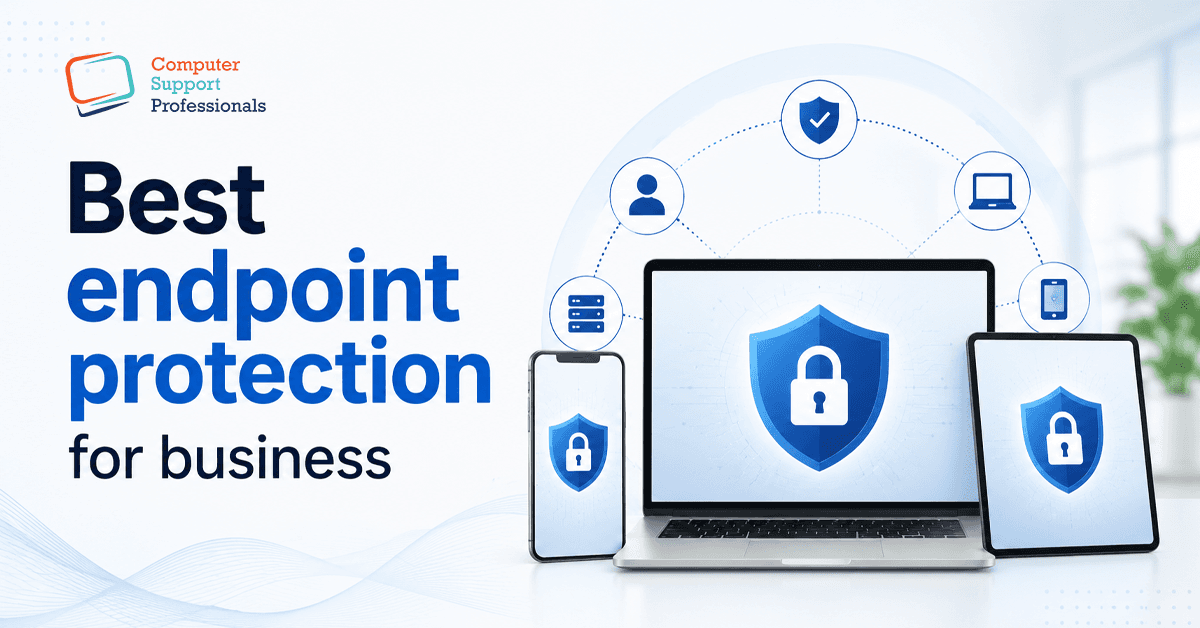
Endpoint protection refers to the technologies and processes used to secure every device that connects to your business network, laptops, desktops, servers, and increasingly, mobile devices and cloud-connected workloads. In a modern hybrid workplace, these endpoints are often the very first point of compromise, simply because they're where people open emails, click links, and work outside the traditional office perimeter.
Endpoint protection is the combination of software, monitoring, and response capabilities that detect, block, and contain threats on individual devices before they can spread across a network.
Ten years ago, endpoint protection and antivirus were basically the same thing. That's no longer true. Antivirus is now just one layer and often the weakest layer in a much broader endpoint security strategy.
Why Traditional Antivirus Software Falls Short Today
Traditional antivirus relies on signature-based detection, which compares files against a database of known malware fingerprints. That approach worked well when most attacks used previously identified malware. It struggles badly against the techniques attackers favour today:
1. Fileless and Living-Off-the-Land Attacks
Modern attackers increasingly avoid dropping a traditional malicious file altogether. Instead, they abuse legitimate Windows tools, PowerShell, Windows Management Instrumentation (WMI), and scheduled tasks to move through your network undetected. Because nothing matches a known signature, standard antivirus software often simply doesn't detect it.
2. Zero-Day Exploits
A zero-day attack exploits a vulnerability before a patch exists. Signature-based tools have nothing to match against, so the attack proceeds unhindered until the damage is already done.
3. Credential-Based Attacks
Many modern breaches don't involve malware at all; they involve a stolen password and a legitimate login. Antivirus software was never designed to flag "a real user logging in from an unusual location at 2 am," but that's precisely the kind of behaviour a modern endpoint security platform is built to catch.
None of these means antivirus is useless; it still blocks a meaningful share of commodity threats. The problem is treating it as a complete defence rather than as one layer of a much larger system.
Antivirus vs EDR vs MDR: What's the Real Difference
This is one of the most common points of confusion for Australian business owners evaluating cybersecurity options. Here's a straightforward breakdown:
| Capability | What It Does | Best Suited For |
| Antivirus / EPP | Blocks known malware using signatures and basic heuristics. | Baseline protection only - never a standalone solution. |
| EDR (Endpoint Detection & Response) | Continuously monitors endpoint behaviour, flags suspicious activity, and enables rapid investigation. | Businesses want visibility and faster detection of real attacks. |
| MDR (Managed Detection & Response) | EDR technology plus a human security team actively monitoring, triaging, and responding to alerts 24/7. | Businesses without an in-house security team - most Australian SMEs. |
For most Australian small and medium businesses, the practical answer is MDR delivered through a managed IT provider because owning an EDR platform without anyone watching the alerts often leaves businesses just as exposed as having no protection at all.
Anatomy of a Modern Endpoint Attack
Understanding how a real attack unfolds makes it much easier to see why detection and response matter as much as prevention. A typical ransomware attack on a business endpoint generally follows this pattern:
- Initial access is usually via a phishing email, compromised credentials, or an exposed remote access tool.
- Reconnaissance: the attacker quietly explores the network to identify valuable systems and backups.
- Privilege escalation: the attacker attempts to gain administrative access to move freely.
- Lateral movement: The attacker spreads from the initial endpoint to servers and other devices.
- Data exfiltration: sensitive data is copied out before encryption, enabling "double extortion".
- Encryption and ransom demand systems are locked, and a ransom is demanded for the decryption key.
Traditional antivirus is only designed to interrupt that chain at step one, and only if the initial payload matches a known signature. Endpoint detection and response is built to spot suspicious behaviour at steps two through five, often stopping an attack well before encryption ever happens.
What the Best Endpoint Protection for Business Actually Looks Like
When Australian businesses ask us what good endpoint protection looks like in 2026, we point to five non-negotiables:
- Behavioural detection, not just signature matching: the platform should flag what a process is doing, not just what file it is.
- 24/7 monitoring and response to attacks don't wait for business hours, and neither should your detection capability.
- Ransomware rollback or containment: the ability to isolate a compromised device and reverse encryption where possible.
- Centralised visibility: a single dashboard showing the security posture of every device, not device-by-device guesswork.
- Integration with patching, MFA, and backup endpoint protection works best as part of a layered strategy, not in isolation.
1. Quick Self-Check:
Ask yourself three questions. If you can't answer yes to all three, your business likely needs to move beyond traditional antivirus:
- If an attack happened on a staff laptop tonight, would anyone see the alert before tomorrow morning?
- Could you isolate a compromised device remotely within minutes, without driving to the office?
- Does your current tool detect suspicious behaviour, or only known malicious files?
How Endpoint Protection Connects to Essential Eight
The Australian Cyber Security Centre's Essential Eight is the baseline cybersecurity framework recommended for Australian organisations of every size. While it was originally built for federal agencies, it's now widely adopted across the private sector and increasingly expected by cyber insurers and corporate clients during procurement.
Endpoint protection directly supports several Essential Eight strategies:
- Application control, restricting which applications can run on a device, is often delivered through the same platform as endpoint protection.
- Patch applications and operating systems; modern endpoint platforms identify unpatched, vulnerable software.
- Restrict administrative privileges, supported by endpoint visibility into privileged account activity.
- Regular backups: the last line of defence if an endpoint is compromised despite every other control.
If your business is being asked to demonstrate Essential Eight maturity, whether by a client, an insurer, or a government contract requirement, your endpoint protection strategy is one of the fastest ways to lift your maturity level.
What Happens If an Endpoint Is Compromised
Under the Notifiable Data Breaches scheme, Australian businesses covered by the Privacy Act must notify affected individuals and the OAIC if a data breach is likely to result in serious harm. A compromised endpoint that exposes customer or staff data isn't just an IT problem; it can trigger legal obligations, reputational damage, and significant remediation costs.
This is precisely why detection speed matters so much. The faster an endpoint compromise is identified and contained, the more likely your business can demonstrate it acted reasonably, and the smaller the potential breach becomes.
How to Choose the Right Endpoint Protection for Your Business
Not every Australian business needs the same level of endpoint protection. Here's a practical way to think about it based on business size and risk profile:
| Business Profile | Minimum Recommended | Why |
| Micro business (1-9 staff) | Modern EPP with cloud management | Lower risk profile, but still needs more than legacy antivirus. |
| Small business (10-49 staff) | EDR with managed monitoring (MDR) | Limited internal IT capacity makes 24/7 monitoring essential. |
| Medium business/government contractor | MDR aligned to Essential Eight ML2+ | Compliance obligations and higher-value data demand stronger controls. |
Conclusion
Choosing the best endpoint protection for business isn't about finding the antivirus with the most checkboxes on a feature list; it's about closing the gap between what your current tools can see and what modern attackers do. Traditional antivirus still has a role to play. Still, on its own, it leaves Australian businesses exposed to exactly the behavioural, credential-based, and fileless attacks that are now the norm rather than the exception.
The businesses that fare best aren't necessarily the ones spending the most on security software; they're the ones that combine behavioural detection with genuine 24/7 response, so an attack gets stopped at step two of the chain instead of step six.