
Today, almost every small and large business uses computers, software and the Internet to carry out its daily operations. When a computer shuts down, e-mail doesn’t work, there’s a problem with the Internet, or a software malfunction, business operations can be affected. In such cases, the IT support team provides assistance so that the problem is resolved as soon as possible and work can resume as usual. The purpose of IT support is to relieve users of technical problems and keep systems running properly.
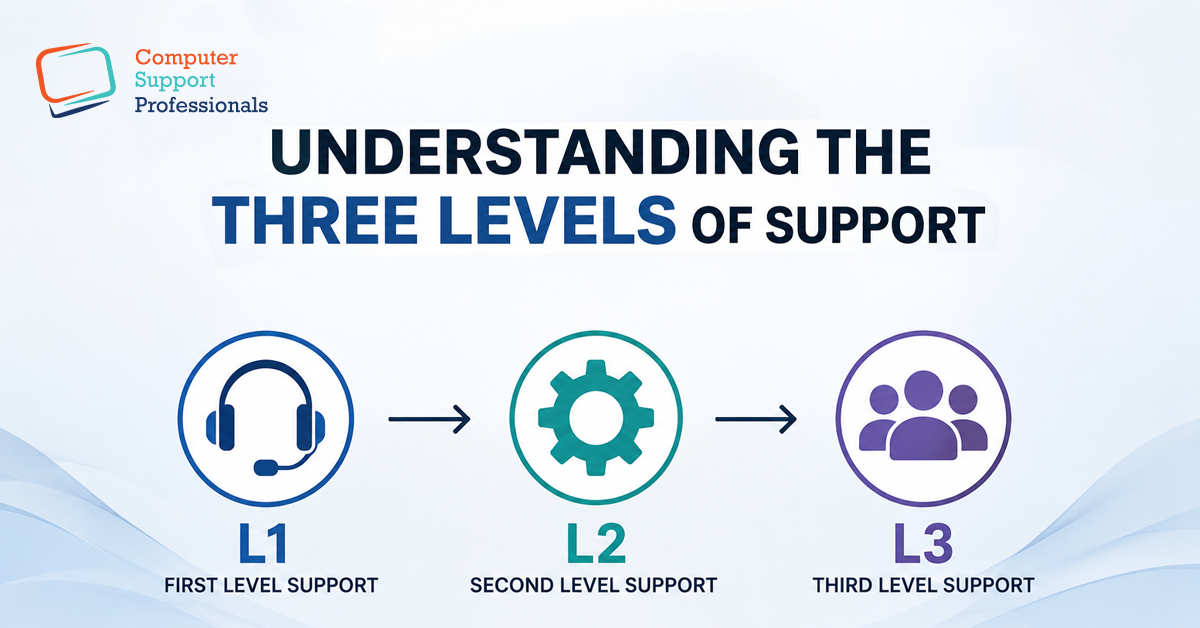
To provide better and faster services, IT support is generally divided into three levels namely L1, L2 and L3. The L1 team solves common and simple problems, such as resetting passwords or providing basic technical guidance. The L2 team is tasked with conducting an in-depth investigation into the matter if it is determined that the issue is more complicated. To handle the most complex and technological challenges is the responsibility of the L3 team.
L1 Support (First Level Support)
L1 help (First Level Support) is the most basic kind of IT help and is the first one. When a user has an issue with a computer, internet or software. They first contact the L1 team. This team aims to answer the common and easy issues instantly so that the work of the user is not delayed for a long. L1 Support is to give immediate help and to resolve first level issues there.
The L1 team usually provides basic technical support such as resetting passwords, troubleshooting email logins, fixing simple software errors, and guiding users in the right direction. Since the problem is more complicated than what the L1 team can handle, they will send it to the next level of help, the L2 team.
L1 Support Responsibilities:
- Password reset
- Troubleshooting email login issues
- View basic software issues
- User guidance
- Preliminary examination of the problem
L2 Support (Second Level Support)
The L1 (Level 1) Support staff supports the customers since they are the main point of contact between the technical team and the workers. If there are difficulties created by the customer inquiries and they are beyond of scope of the L1 team then the L2 or the Level 2 team will be roped in to achieve the aim of delivering the complete help.
L2 Support addresses issues that are less complex, such as network failures, major software errors, or system configuration issues. This team tries to get to the root of the problem and fix it. If an issue still cannot be resolved, it is escalated to a higher level, L3 Support, where highly skilled engineers work on it.
Responsibilities of L2 Support:
- Software bug testing
- Solving network problems
- System configuration
- View server related issues
- Analysis of complex technical problems
L3 Support (Third Level Support)
L3 Support (Third Level Support) L3 support is the highest and most sophisticated level of IT Support. The team is made up of highly skilled individuals such as software developers, system architects and senior engineers. These are the folks who work on the hard challenges that the L1 and L2 teams can’t solve.
L3 Support troubleshoots complex system faults, software bugs and develops new solutions or upgrades. This team has a strong understanding of the system internals and offers end-to-end solutions to technical problems. When a big or critical issue arises , it is fixed at that level so that the system may work at its best again .
L3 Support Responsibilities:
- Troubleshoot complex system problems
- Fix software bugs
- Developing new updates and patches
- Solving system design issues
- Provide technical assistance to other support teams
Difference between L1, L2 and L3
| Support Level | Skill Level | Type of Issues |
| L1 | Basic | Common and simple issues |
| L2 | Intermediate | Technical and complex issues |
| L3 | Advanced | Highly complex and development-level issues |
Conclusion
These three levels of IT support help organisations provide better and faster services. L1 solves basic problems, L2 handles more complex technical problems, while L3 provides solutions for more difficult and deep technical problems. Thanks to this system, customers get timely assistance and business operations continue without interruption.