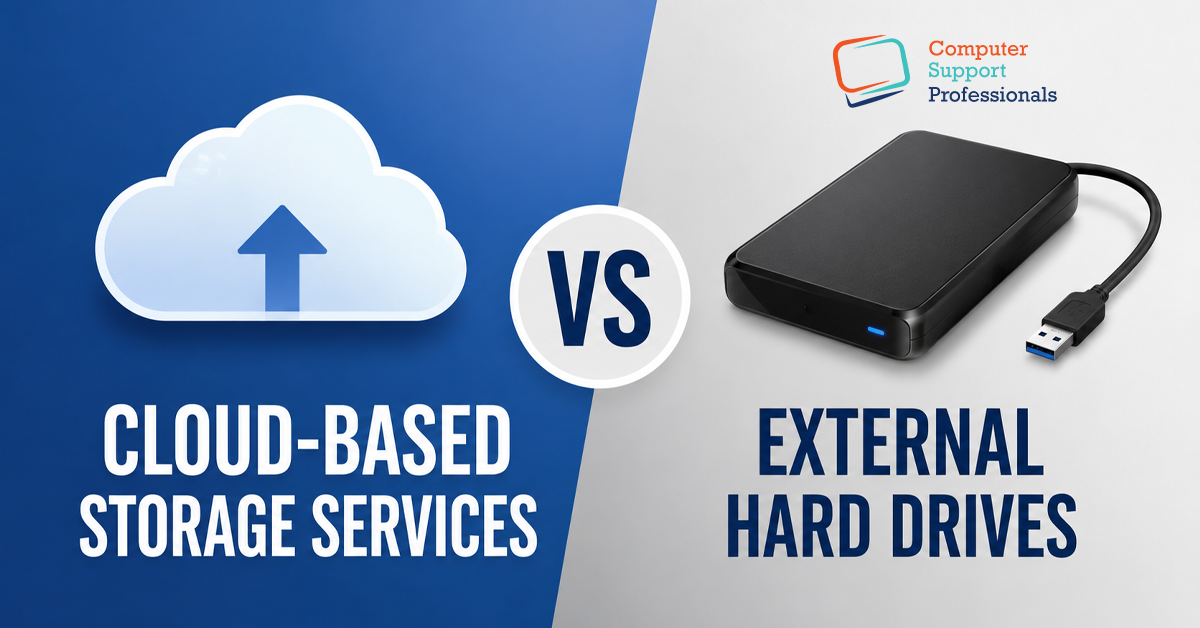

Cloud Based Storage Services has become very important for every business in today’s era. The entire business system runs on customer information, cash registers and important files. If this data is lost, the business can suffer a lot. That’s why people use two common methods to keep their data safe: cloud storage and external hard drives.
Cloud storage is a method in which data is stored on the Internet. An advantage is that you can use your data anywhere and anytime from your mobile or computer. That reduces the risk of data loss as it is kept on secure servers. On the other hand, an external hard drive is a small physical device that stores data. That’s why you don’t need the internet to use it, and you have it with you.
Both methods have their advantages and disadvantages, so it is better to use both in business to keep data more secure.
Cloud Based Storage Services
Cloud Based Storage Services is a way in which your data is stored on the Internet. What this indicates is that your data are not kept on a single machine but rather on servers that are located online. And you can easily access and use your data from your mobile, laptop or any device sitting anywhere.
These services use large and powerful server machines that are always on to protect your data. It reduces the risk of data loss and often has automatic backups. People all around the entire world make use of cloud services such as Google Drive, Dropbox, and Microsoft OneDrive. These services are among the most popular Cloud Based Storage Services.
External hard drive
An external hard drive is a physical device that you connect to a computer or laptop via USB. Through it you can save your files, photos, videos and other important data. You can easily extract your data from the USB drive whenever needed.
Its special thing is that it does not require the internet to use it. And you can take it anywhere and use it offline. External hard drives are available in different sizes and storage capacities, and once purchased, they can be used for a long time.
Security comparison
-
Data Theft
The risk of data theft in cloud storage is relatively low because it uses advanced security systems. For example, encryption means that your data is converted into a special code that can only be read by an authorised person. There is also multi-factor authentication which involves multiple authentication steps for login, such as OTP along with password. This makes it difficult for hackers to access the data.
On the other hand, data in an external hard drive is stored only by the person who owns the device. Anyone who steals your hard drive and it’s not encrypted can easily see or copy all the data on it. Therefore, physical security becomes very important. If the drive is lost or falls into the wrong hands, data can be at risk. This is why cloud storage is considered more secure in terms of security.
-
Risk of data loss
Cloud storage reduces the risk of data loss as your data is stored on different secure servers. Even if your mobile, laptop or computer gets damaged, your data is saved and you can retrieve it from another device. In addition, cloud services often have automatic backups that make data recovery easier.
In contrast, an external hard drive is completely a physical device. If it is dropped, damaged or has a technical problem, the data on the drive can be lost forever. Sometimes it is very expensive and difficult to recover. That’s why it can be dangerous for a business to depend only on hard drives. In this sense, cloud storage is more secure and reliable.
-
Dependence on the Internet
The main advantage of cloud storage is that an organisation can access data from anywhere in the world, just through the internet. If we talk about the disadvantages of cloud storage that if there is no internet, you cannot access files and data. This would be a problem, especially in areas where the internet has poor connectivity.
In contrast, using an external hard drive does not require any internet connection. You can instantly access your data by connecting it to a computer via USB. It is very easy to work offline. If the internet is down, your work will not stop. That’s why a hard drive is a better and easier solution in terms of the Internet.
-
Control (Control over Data)
In cloud storage, your data is stored on a large company’s server. This means that you do not completely own it, but you depend on the service. If the company changes its policy or there is a problem with the account, you may have problems. So the control here is relatively less.
In contrast, an external hard drive is completely in your hands. Your data is saved only by you and you can use it at any time. No third party has any control over it. It gives a sense of freedom and complete ownership. Therefore, in terms of control, the hard drive is considered better.
-
Backup and recovery
In cloud storage, the backup system is automated. This means that if you accidentally delete a file, you can easily get it back. In addition, different versions are stored in the cloud, from which old data can be retrieved.
This feature is not automatic in hard drives. If you don’t make a backup yourself, it becomes very difficult to recover the data after it is lost. In some cases, expensive services are also required for data recovery. Therefore, cloud storage is a more convenient and secure method in terms of backup and recovery.
-
Cost
There is often a monthly or yearly subscription associated with cloud storage, particularly if you utilise a greater amount of storage space. There is a possibility that this storage expense may accumulate over time; but, in exchange, organisations will get improved defense and simpler access.
On the other hand, an external hard drive is a one-time purchase and you can use it for a long time. There is no monthly fee, so it is more affordable and economical. However, if it gets damaged, it may have to be re-purchased. In terms of cost, the hard drive is the cheapest solution.